What Is a Good 10-Key Speed for 2026?
Updated January 2026 · 10KeyPro Editorial Team

Quick Answer

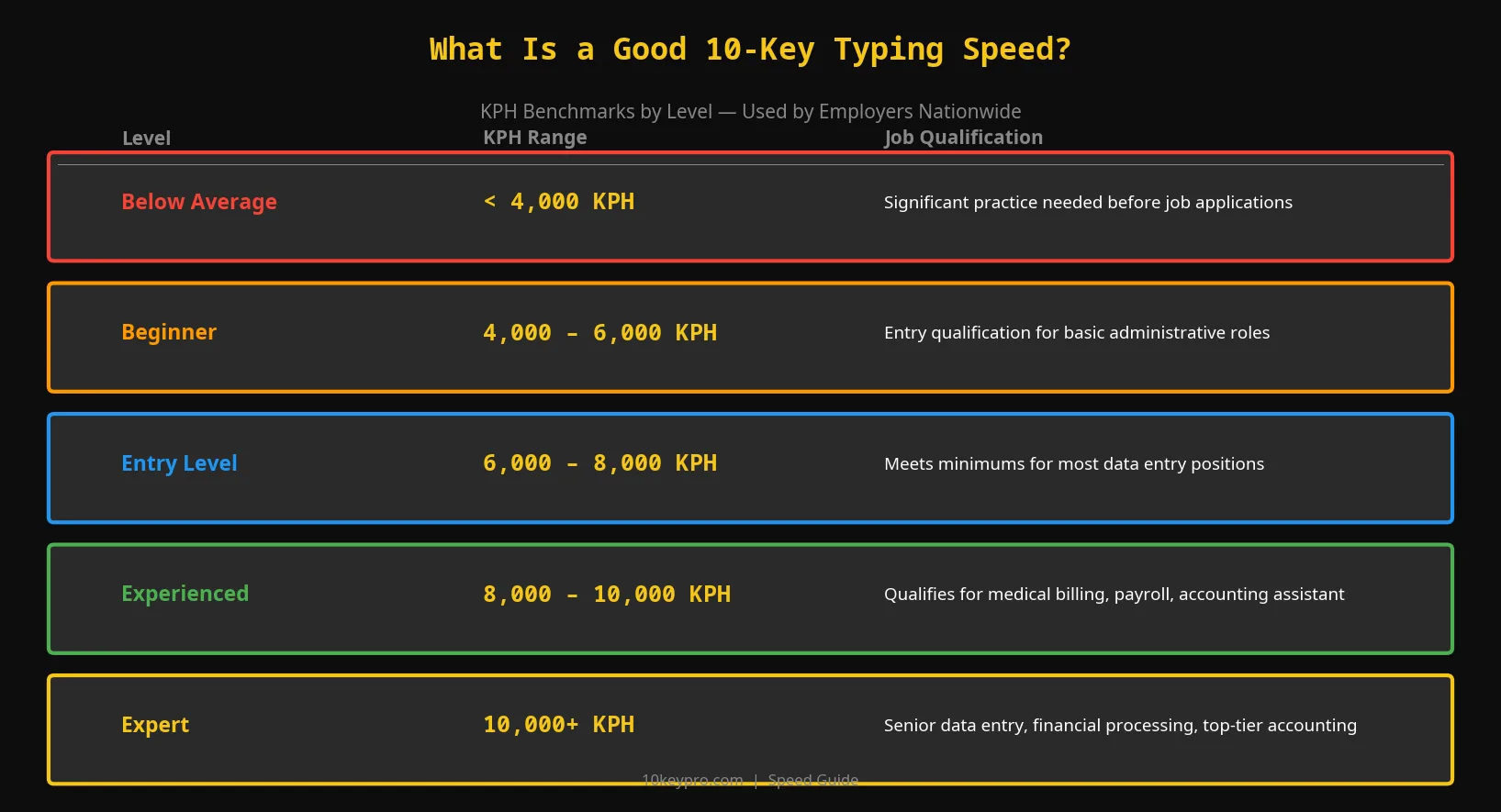
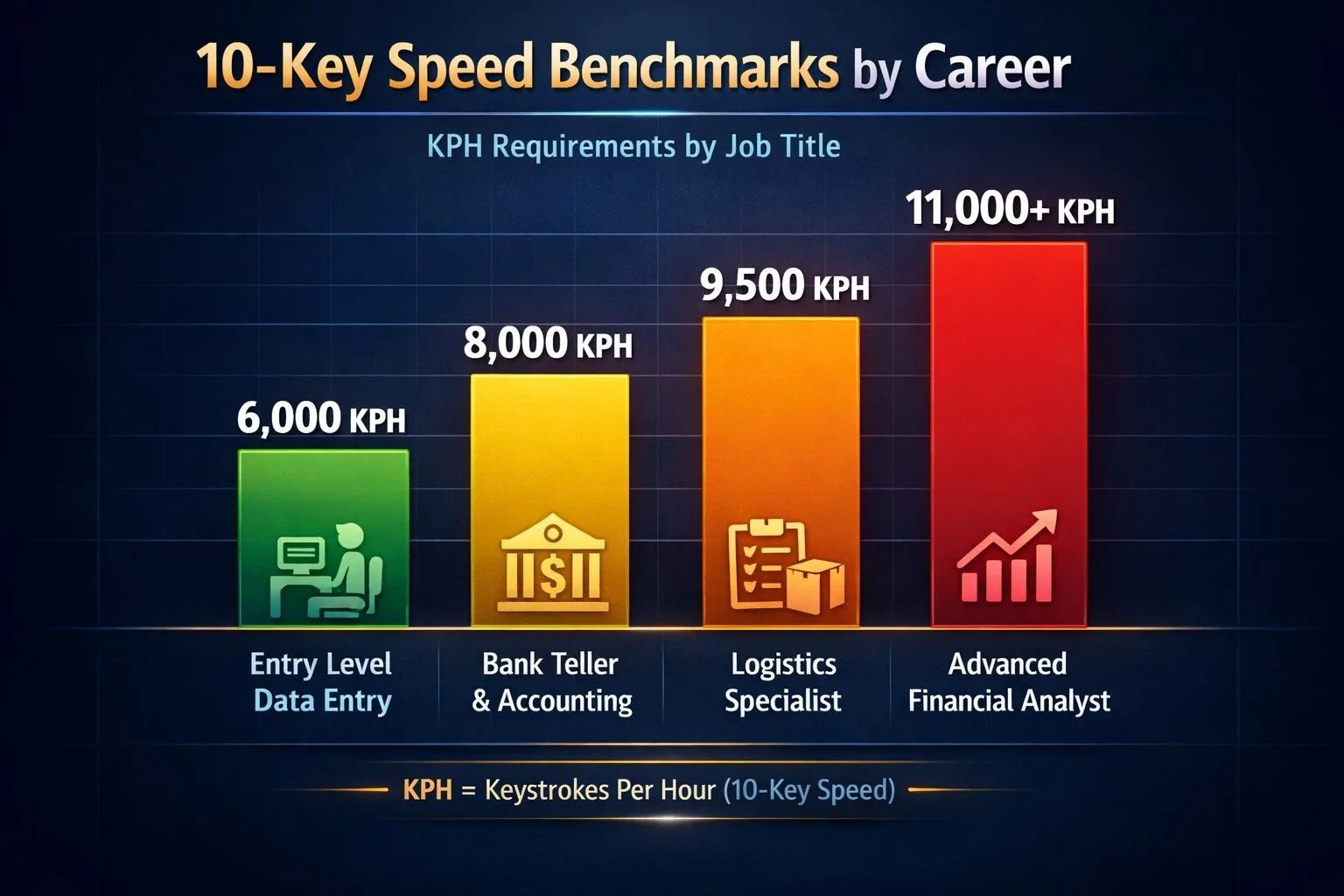
A good 10-key speed in 2026 depends on your target role. Entry-level data entry requires 8,000 KPH at 95% accuracy. Medical billing and banking roles require 10,000-12,000 KPH at 98-99% accuracy. Forensic accounting may require 12,000+ KPH at 100% accuracy.
Good 10-key typing speed guide by job role 2026

A good 10-key speed depends entirely on your career goals and target industry. The answer varies by more than 4,000 KPH depending on whether you are targeting a receptionist role or a financial auditing position. Knowing your target tier before you start training is the difference between a 3-week path and a 3-month one.

2026 Speed Targets by Role

6,000 KPHReceptionist / general office — acceptable entry point 7,000–8,000 KPHData Entry Clerk / Clerical — professional baseline 8,000+ KPHBookkeeping / Accounting — standard with 98%+ accuracy required 9,000 KPHPayroll / AP Clerk — competitive, prioritizes decimal accuracy 10,000+ KPHMedical Billing / Financial Auditing — expert tier, near-zero errors

The Net KPH Reality in 2026

Professional firms increasingly use Net KPH as the primary screening metric, which subtracts an error penalty from your gross score. A score of 8,500 KPH with 99% accuracy is significantly better than 11,000 KPH with 90% accuracy. The high-error candidate creates more re-work liability than they eliminate through speed.

Chasing raw KPH at the expense of accuracy is a career-limiting strategy. The "good" typist in 2026 is the one with the best Net KPH — the highest consistent speed they can sustain while maintaining 98% or greater accuracy across different data types.

Consistency Across Data Types

Many typists perform well on simple whole numbers but slow significantly when hitting decimals, operators, or multi-field sequences. Employers who conduct in-person tests specifically design their test sets to include all data types. The hallmark of a truly good 10-key typist is maintaining their KPH benchmark whether entering zip codes, currency amounts, or 12-digit account numbers.

Self-Assessment: Run separate 1-minute tests on whole numbers, currency (with decimals), and zip codes. If any category is more than 1,500 KPH below your best, that gap is your training priority — not overall speed.

How to Measure Where You Stand

Before you can improve your KPH, you need a baseline. The most accurate way is to simulate the exact test format your target employer uses: a 1-minute timed sprint on numeric data entry. Take your baseline here: Free 10-Key KPH Test →

Frequently Asked Questions

Is 8,000 KPH good enough to get a data entry job?
For general data entry and office administration roles, yes. Most ATS screening systems set 8,000 KPH as the automatic filter threshold.

How long does it take to reach 10,000 KPH?
Starting from zero, most people reach 10,000 KPH within 4 to 8 weeks of daily 20-minute practice sessions using structured drills and a mechanical keypad.

Do employers verify KPH scores?
Most professional employers administer their own timed test during hiring regardless of self-reported scores. Your reported KPH gets you past initial screening — the employer test determines the offer.

Pro Tip: When reading a job posting, "10-key required" without a number usually means 8,000 KPH minimum. "10-key preferred" means you need at least 6,000 to be competitive. Any posting that lists a specific number (10,000+) has an ATS hard filter — you will not advance below that threshold regardless of other qualifications.