How Long Does It Take to Learn 10-Key Typing?
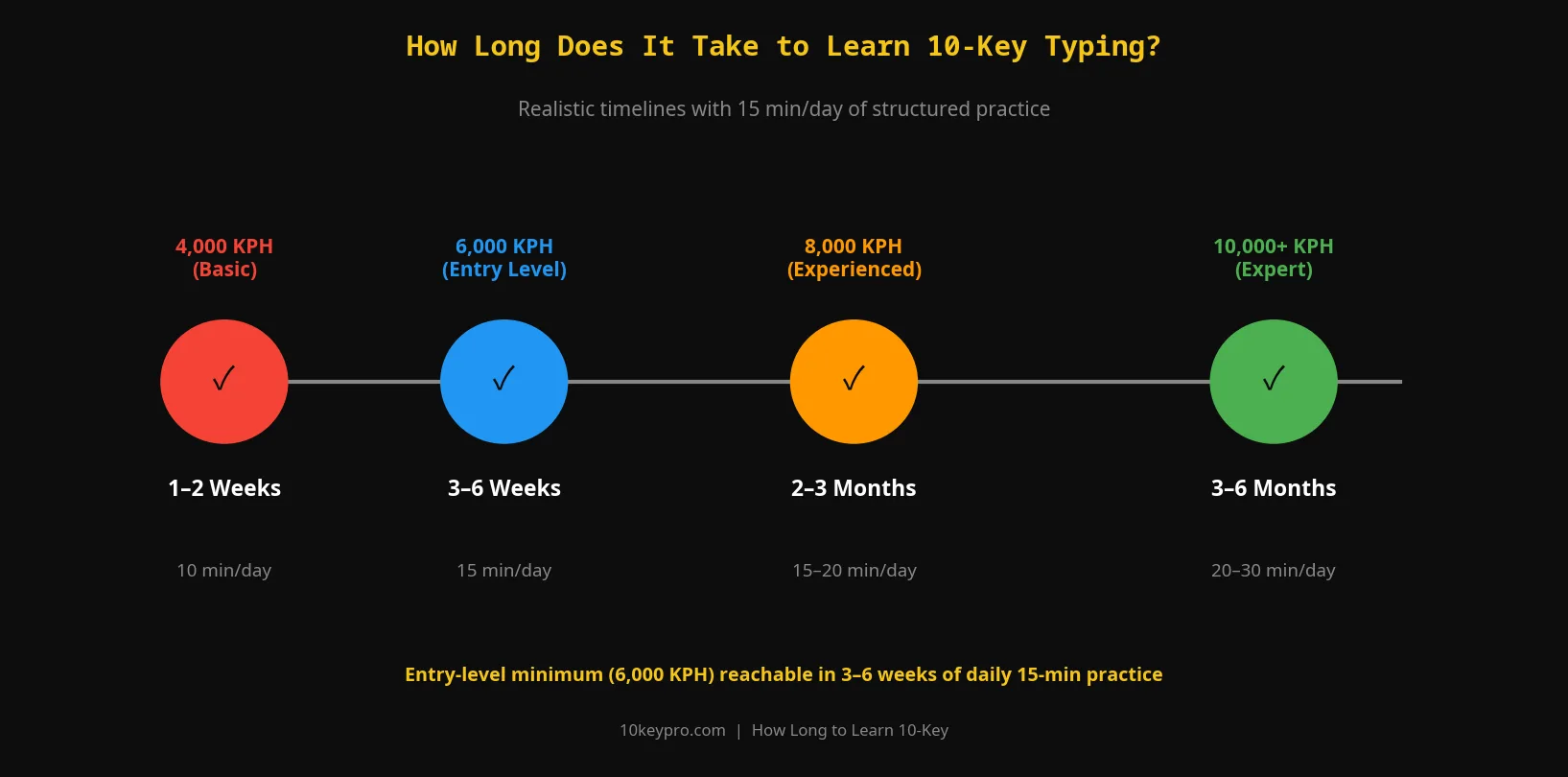
Most people reach an entry-level professional speed of 8,000 KPH in 4 to 6 weeks of structured daily practice. Getting to 12,000 KPH typically takes 3 to 6 months. The main variable is how consistently you practice and whether your sessions target real data entry patterns.
Mastering the 10-key layout is a journey of muscle memory, not intellect. While you can identify where the numbers are in approximately 15 minutes, reaching employment-ready speeds of 8,000+ KPH typically takes 2 to 4 weeks of consistent, daily practice. The timeline is determined by how frequently you practice and how deliberately you structure your sessions.
The 30-Day Training Roadmap
- Days 1–7 (Accuracy Only): Focus entirely on the 5-key anchor. Your only goal is 100% accuracy at any speed. Do not check your KPH during this phase.
- Days 8–14 (Building the Reach): Introduce diagonal reaches, the decimal point, and the Enter key rhythm. You will feel slower as your brain builds new neural pathways - this is normal and necessary.
- Days 15–21 (The Speed Burst): Begin 1-minute timed sprints. Most learners see KPH jump from 4,000 to 7,000 in a single week as pattern recognition begins to replace conscious visualization.
- Days 22–30 (Refinement): Focus on Clean Data drills - currency (decimals and 00 key), zip codes (5-digit patterns), and 12–16 digit account numbers. This is where you push toward the 9,000+ KPH Gold Standard.
Why Short Sessions Beat Long Marathons
Muscle memory is built through frequency, not duration. Practicing 15 minutes every single day is significantly more effective than a 3-hour session on Saturday. Your brain needs sleep cycles to consolidate the motor patterns learned during the day. A daily schedule gives your brain seven consolidation cycles per week instead of one.
Breaking the 6,000 KPH Plateau
Most learners stall at 6,000 KPH. Breaking through requires a deliberate mental shift: moving from thinking about the number to reacting to the visual pattern. Temporarily reduce your accuracy threshold to 95% and allow yourself to move faster than feels comfortable. The brief dip in accuracy recovers within 3 to 5 sessions once the new speed pattern is set.
Factors That Accelerate Your Timeline
- Hardware quality: A mechanical keypad with tactile switches reduces learning timeline by 30-50% versus a laptop keyboard.
- Session frequency: Daily 20-minute sessions build muscle memory faster than longer, infrequent sessions.
- Pattern-based drills: Practicing real data patterns (zip codes, invoices, account numbers) trains pattern recognition faster than random digits.
Start your baseline test: Free KPH Test →
See also: Professional 10-Key Training Software
"A proficient typist can easily perform more than 18,000 keystrokes per hour."- U.S. Occupational Safety and Health Administration, Computer Workstations eTool
What Slows the Learning Curve
Several factors extend the time it takes to reach professional 10-key speed. The most common is practicing on the wrong hardware. If you train on a laptop number row instead of a dedicated numeric keypad, the muscle memory you build will not transfer, and you will essentially start over when you switch to a proper keypad. The second most common factor is inconsistent practice. Missing three or four days in a row resets recent tactile memory gains and adds weeks to the learning curve. The third factor is skipping the accuracy phase and jumping straight to speed drills. Errors trained into muscle memory are significantly harder to undo than a speed plateau is to break through. All three of these factors are controllable with the right equipment, a daily schedule, and a structured accuracy-first training approach.
Realistic Timelines for Different Starting Points
Complete beginners with no prior numeric keypad experience typically reach an entry-level 8,000 Net KPH in four to six weeks of daily 20-minute practice. Typists with existing touch-typing skills on a standard keyboard tend to reach the same benchmark in two to three weeks because their underlying rhythm and touch discipline transfers. Typists who have used a numeric keypad in a previous job but never formally timed themselves often find their baseline is already 5,000 to 7,000 KPH, and they can reach employment-ready speed in one to two weeks of targeted drill work.